

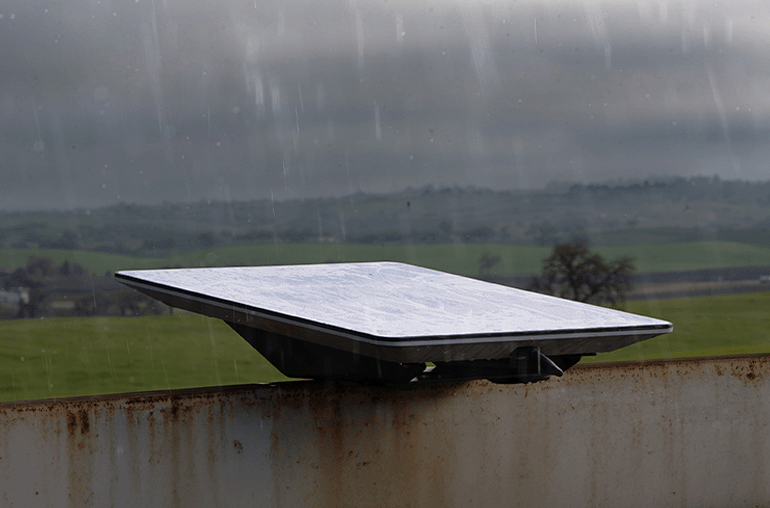
Enterprise networks go down for any number of reasons, from flooding and wildfires to hurricanes and regional outages. When this happens, waiting for service restoration is not a plan. Starlink gives enterprises a satellite path back online, one that can fully replace a downed circuit immediately, or stand up connectivity in minutes at a site that never had a terrestrial option to begin with.
When connectivity goes down, business suffers, and speed to restoration is critical. Emergency teams, distributed offices, temporary command posts, and other critical sites need connectivity fast, so staff can stay coordinated and work keeps moving forward. In many of these scenarios, Starlink is not just a fallback option, it is the fastest way to get a site connected in the first place.
What Is Starlink for Emergency Response and Disaster Recovery?
Starlink is a satellite internet service that utilizes a constellation of Low Earth Orbit (LEO) satellites to keep enterprise-grade connectivity even when terrestrial circuits fail. For established locations, Starlink can run as a backup internet plan, a failover layer that activates the moment the primary circuit goes down. For temporary command posts, mobile units, and newly stood-up field sites, Starlink is often the primary connection from day one.
The distinction between primary and backup use matters for planning purposes, but the objective stays the same either way: keep essential applications and remote access available so teams can keep working. A Starlink backup internet plan is built around continuity, and that same principle applies when Starlink is carrying all of a site’s traffic instead of just the overflow from a failed circuit.
If an organization has mission-critical branch sites, field crews, or public safety responsibilities, Starlink can reduce the impact of a service disruption to a minor delay, and it can bring connectivity to locations that would otherwise have none.
What are the Benefits of Starlink for Enterprise Networks?
Enterprise networks handle a lot of traffic on a normal business day, and during disaster scenarios, just when teams need connectivity most, terrestrial networks can go down entirely. Satellite internet gets teams back up and running without relying on vulnerable land-based infrastructure, and it can extend a network to cover even the most remote or dispersed locations.
Independence From Terrestrial Failure Points
All terrestrial networks share the same ground-based risk factors: construction damage, power loss from electrical storms, flooding, and regional outages can take multiple service providers down at once. Starlink gives teams a path independent of buried cables, weather-vulnerable poles, and local access networks entirely.
Rapid Deployment
Speed matters for command centers, mobile response units, and other sites that need an immediate communications bridge, and Starlink can be deployed as quickly as needed. Contrast this with waiting for a carrier truck to arrive during a wide-open service window, and the advantage becomes clear, both for restoring a failed circuit and for standing up a brand-new site.
The faster connectivity can be deployed, the faster teams can coordinate next steps, share status updates, and bring critical workflows back online.
Coverage Across Remote and Distributed Sites
Many organizations don’t have a single centralized headquarters but instead operate dozens or hundreds of sites scattered across regions, many in places where terrestrial options are thin to begin with. Starlink gives these teams a path that can reach sites where traditional broadband is weak, inconsistent, or simply unavailable, closing coverage gaps a satellite backup internet option alone couldn’t reach on its own.
Real World Customer Example
When severe storms knocked out internet access in Texas, one gas, food and beverage retailer needed a way to stay connected. MetTel quickly redirected a nearby Starlink satellite to restore service, keeping operations running while surrounding businesses went dark.
With MetTel’s Managed Starlink for emergency response, the customer maintained uninterrupted connectivity and stayed open to serve the community when it mattered most.
How Does Starlink Support Emergency Response and Disaster Recovery?
MetTel Managed Starlink for emergency response works by giving responders and field teams a satellite connection they can stand up quickly, independent of the condition of the local terrestrial network. During emergency response actions, connectivity ties dispatch, logistics, field reporting, and leadership together, and Starlink emergency satellite internet can help organizations restore, or establish for the first time, communication where terrestrial infrastructure has been damaged, cut off, or never existed at a site.
Typical deployment scenarios include:
- Restoring internet access at a damaged branch or operations site
- Establishing temporary command posts after a natural emergency
- Standing up connectivity at a newly designated site with no existing circuit, in many instances accelerating Certificate of Occupancy building permits.
- Supporting field teams with a live connection for reporting and coordination needs
- Maintaining voice service, collaboration tools, and core applications when local networks are unstable
In practice, satellite internet enables teams to keep working while restoration efforts continue on the ground, or while a permanent terrestrial circuit is still being installed, instead of forcing them to wait before they can communicate again.
Disaster recovery satellite internet is a connectivity layer, delivered over satellite rather than fiber or cable, that keeps operations running when a primary event disrupts terrestrial infrastructure, or when a recovery site has no terrestrial infrastructure at all. A resilient enterprise disaster recovery plan doesn’t rely on one tool alone. It layers connectivity options so if one path fails, or a location was never wired in the first place, another is ready to take over. Starlink fits into that wider architecture alongside routing, cellular fallbacks, and managed oversight, often rivaling the performance of terrestrial connectivity.
Rapid Deployment for Temporary or Crisis Sites
Most recovery sites are temporary by design. Crisis offices, mobile support centers, and resource staging areas need to get field teams to work fast, then come down once the situation is under control. Satellite internet fits these scenarios well because it can go live without waiting for a terrestrial build-out.
SD-WAN and Starlink: Added Resilience Through Orchestrated Failover
With software-defined wide area networking (SD-WAN), traffic can shift to Starlink automatically when the primary circuit goes down. This removes the delay and confusion that often accompanies manual failovers, especially when an outage hits after hours or affects multiple locations at once.
MetTel was the first Authorized Starlink Reseller to provide managed SD-WAN solutions over Starlink. MetTel’s Managed SD-WAN gives customers the flexibility to combine multiple connection types, including MPLS, broadband, 5G, 4G-LTE, and Starlink, into a single, cloud-controlled network. Layering Starlink into that mix adds another high-bandwidth path that SD-WAN can intelligently use to route traffic. Together, MetTel’s Managed SD-WAN and Starlink give customers a network that performs better on a normal day and stays resilient on the worst one.
How Starlink Fortifies Critical Emergency Response Infrastructure
Copper lines carry their own risk factors, especially for critical services like alarms and elevators still tied to legacy POTS infrastructure. A POTS replacement approach moves these services to modern alternatives, creating a built-in backup layer and these solutions can integrate with Starlink for added resilience for those services.
Why is Starlink a Trusted Solution by the Federal Government?
Government agencies face many of the same connectivity gaps as commercial enterprises, remote field offices, disaster response teams, temporary facilities, and sites where terrestrial infrastructure is limited or unreliable, but with added requirements around procurement, security, and oversight.
A managed approach gives agencies a single point of accountability for deployment, monitoring, and support. This matters for continuity of operations planning, where a federal site’s connectivity needs can shift as the mission changes, without requiring a new contract or a different vendor each time.
For federal buyers, working with a managed services provider also means Starlink deployment can align with agency procurement processes and existing vendor relationships, rather than requiring a separate standalone contract for satellite service.
Is Starlink Foolproof?
No connectivity option is perfect, and satellite internet is no exception. Like any option (even terrestrial ones like mobile broadband), satellites in some instances can be affected by latency, weather conditions, bandwidth limits, and environmental factors. The key question is whether a service can deliver enough connectivity, fast enough, to keep business or response efforts moving in a compromised state.
Practically speaking, physical site needs like a clear view of the sky for reliable signal reception, and distance to routers and switches are critical path decisions to ensure the service will be free from any constraints on what applications should use the link. Managed Starlink solutions offer even greater reliability through centralized visibility and additional features.
Many of these limitations come down to how a terminal gets installed, not the technology itself. MetTel’s professional installation service starts with a site survey to confirm dish placement with a clear, unobstructed view of the sky, the biggest factor in avoiding future service issues. Installation also includes all necessary cables and mounting hardware provided at the time of setup, so field teams are successful on installation day and not required to revisit costing money and time delays.
Why MetTel for Starlink Deployment?
MetTel adds Starlink to its broader networking services, SD-WAN orchestration, and portal-driven visibility, so you can see what’s happening across every location and respond fast, whether a circuit fails or a new site needs to come online. That includes managed Starlink for federal government agencies, where MetTel handles deployment and monitoring so internal teams aren’t left managing satellite hardware on their own. With Managed Starlink services from MetTel you get:
| Category | Feature |
| Deployment | Ready-to-ship inventory of Starlink models for rapid deployment |
| Professional Services | Optional professional services, including site survey, dedicated project management, installation, and on-site repair |
| Support | 24/7/365 US-based live customer support |
| Billing | One consolidated bill, no credit card required |
| Financing Options | Financing options available for both installation and Starlink equipment costs |
| Reporting | Industry-exclusive reports and state-of-the-art executive dashboards |
| Simplified Management | Streamlined bulk terminal management without individual device logins or frequent password resets |
| Secure Access | Highly secure, multi-tenant management dashboard for multiple users with 2FA |
When you’re ready for a connectivity model built for both everyday primary use and disaster recovery, get started today and talk through the right deployment path for your environment with our team of experts.
Frequently Asked Questions
Can Starlink be used for emergency response?
Yes. MetTel managed Starlink for emergency response ships as a self-contained kit, dish, router, and power, so field teams can bring connectivity wherever the response is happening instead of waiting on a technician or a new circuit build.
What is disaster recovery satellite internet?
Disaster recovery satellite internet is the layer that closes the gap between a primary circuit failing and full restoration, which keeps that gap from extending your recovery time objective. It’s typically layered alongside SD-WAN and cellular failover rather than used on its own.
Can Starlink be used as a primary internet connection?
Yes. Starlink can serve as a primary connection or as a backup connection to enhance network resilience.
Does MetTel offer managed Starlink for federal government?
Yes. MetTel provides managed Starlink for enterprises and federal government agencies, including 24/7 monitoring and support, so a connectivity issue gets flagged and addressed without the agency needing satellite specialists on staff.